Videos

Build Trusted Agentic Applications with Trillo AI

Everyone is building AI agents — but very few are building them right.

About this video

Watch Link

Agentic applications aren’t just chatbots with better prompts. They’re complex systems: multiple agents coordinating, tools accessing live data, humans in the loop, and governance baked in from day one.

Yet most teams start the same way:

❌ Messy whiteboards

❌ Weeks of debate

❌ Misaligned mental models

❌ Agents that work in demos — and fail in production

AI is ready. The architecture process isn’t.

That’s where Trillo AI comes in.

Trillo AI introduces Architected AI — a blueprint-first approach to building reliable, auditable, production-ready agentic applications.

What Trillo AI does

Generates complete agent architectures in minutes, not months Defines agent roles, MCP tools, data access, and governance workflows Keeps business leaders, architects, and engineers aligned on one shared system Produces structured design artifacts and production-ready code Enables human-in-the-loop oversight, audit trails, and compliance by design

Real-world proof

In this video, you’ll see how an Aircraft Maintenance, Repair & Overhaul (MRO) platform was built using Trillo AI:

Predictive maintenance agents Automated work order routing Human approval at critical decisions Full audit trails 70+ APIs and 9 user roles — generated from a blueprint

The same approach works across manufacturing, supply chain, space operations, and any domain where AI agents must be trusted in production.

The takeaway

Stop improvising agent architectures. Stop prompt-and-pray. Stop vibe-coding systems you can’t trust.

Generate the structure. Align the team. Build AI agents that ship — and stay reliable.

Thumbnail for Build Trusted Agentic Applications with Trillo AI

From Requirements to Blueprint

How Trillo AI Turns Ideas into Production-Ready Software

About this video

Watch Link

Software isn’t about guessing. It’s engineering.

In this video, we walk through how Trillo AI transforms plain-language requirements into structured, production-ready software blueprints step by step.

You’ll see how Trillo AI helps architects, developers, and product teams move beyond vibe coding and adopt a spec-driven, engineering-first approach to building software.

🔍 What you’ll learn in this walkthrough:

How to convert raw requirements into detailed software specifications Editing and refining specs using a chat-based AI architect Generating system architecture across presentation, API, services, and data layers Getting cloud service recommendations and cost estimates Creating AI-generated effort estimates for planning and proposals Publishing a secure, shareable project blueprint for stakeholders

Trillo AI brings structure, clarity, and accountability to modern software development — combining human judgment with AI precision.

If you’re building enterprise applications, planning cloud deployments, or tired of unstructured AI code generation, this video is for you.

Thumbnail for From Requirements to Blueprint

From Specification to Design

How Trillo AI Structures UI, Data Models & APIs

About this video

Watch Link

Design is where software ideas turn into real, buildable systems.

In this video, we walk through the Design Phase in Trillo AI, showing how teams move from high-level specifications to detailed UI scenarios, object models, and API definitions—all within a structured, engineering-first workflow.

Rather than jumping straight into code, Trillo AI helps you navigate and refine design artifacts step by step, keeping everything aligned with the original specifications.

What this video covers:

  1. Navigating top-level software specifications and design activities
  2. Understanding how design builds on previously defined requirements
  3. Creating and refining UI scenarios and user flows
  4. Exploring detailed object models and data structures
  5. Defining API endpoints and components
  6. Maintaining clarity across design artifacts without unnecessary rework

This approach helps product teams, architects, and engineers stay aligned—reducing ambiguity, rework, and missed requirements during development.

If you’re looking to move beyond unstructured AI outputs and adopt spec-driven, blueprint-based software design, this walkthrough shows how Trillo AI supports that process.

Thumbnail for From Specification to Design

Trillo AI Requirement Analysis

AI That Finds Requirement Gaps Before They Cost You

About this video

Watch Link

Missing requirements are one of the biggest causes of cost overruns and failed software projects.

In this video, we show how Trillo AI uses AI-driven requirement analysis to identify gaps, ambiguities, and inconsistencies before development begins.

Instead of producing a static report, Trillo AI acts like a digital interviewer—asking targeted, structured questions that help teams clarify scope, uncover hidden assumptions, and eliminate uncertainty early.

🔍 What you’ll see in this walkthrough:

Uploading an existing requirement document

How AI agents analyze requirements to detect gaps and risks Turning missing details into structured Q&A Answering questions using multi-select and free-text inputs Maintaining human-in-the-loop control by removing irrelevant questions Iterating through refinement cycles to sharpen requirements Finalizing and accepting a clear, comprehensive specification

This approach helps product managers, architects, and engineering teams reduce rework, control scope, and build with confidence—long before coding starts.

Mitigate risk. Eliminate ambiguity. This is Software Development using Blueprint.

Thumbnail for Trillo AI Requirement Analysis

Trillo AI Workspaces

Build Securely, Collaborate Confidently

About this video

Watch Link

In Trillo AI, collaboration starts with structure.

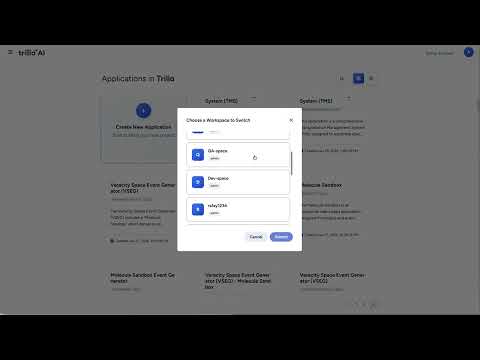
This video explains how Trillo AI Workspaces help teams build software securely by organizing applications, users, and permissions into isolated environments.

A Workspace acts as a secure container for one or more applications, giving teams clarity, access control, and architectural governance—without slowing anyone down.

What you’ll see in this walkthrough:

🔍 What a Workspace is and how it organizes applications How teams collaborate inside a shared, secure environment Switching between multiple workspaces with ease Creating new workspaces for different teams or projects Inviting team members and assigning User or Admin roles Managing access with admin controls like role changes and user deactivation

Trillo AI Workspaces are designed for enterprise-grade collaboration, where security, isolation, and control matter just as much as speed.

Whether you’re scaling teams, managing multiple projects, or enforcing clear ownership across applications, Workspaces provide the foundation for spec-driven, blueprint-based software development.

Build with isolation. Scale with security. This is Software Development using Blueprint.

Thumbnail for Trillo AI Workspaces

Trillo AI: From Requirements to 100K Lines of Code

Building enterprise software usually takes months of planning, architecture design, and development.

About this video

Watch Link

Building enterprise software usually takes months of planning, architecture design, and development. But what if AI could compress that process into days?

In this video, we show how Trillo AI generated a working scaffold for a complex Aircraft Maintenance, Repair, and Overhaul (MRO) application in just one week — producing over 100,000 lines of well-structured code.

With Trillo AI, teams can transform ideas and requirements into structured application blueprints, architecture, and baseline code, reducing project risk and giving stakeholders early visibility into how the system will work.

This approach helps organizations move faster, align teams earlier, and build better applications from day one.

Thumbnail for Trillo AI: From Requirements to 100K Lines of Code